


Private Pilot License Course in India: Eligibility, Training and Benefits
Flying an aircraft is a dream for many people. Some want to become professional pilots, while others want to fly for personal travel, adventure or recreation. A Private Pilot License course in India provides the basic knowledge, practical training and flying experience needed to operate a light aircraft safely.
A Private Pilot License, commonly called a PPL, allows a qualified person to fly an aircraft for private purposes. However, a PPL holder cannot work as a paid airline or commercial pilot. Aerostar Aviation Academy offers PPL training that includes ground preparation, simulator sessions and practical flying experience.
What Is a Private Pilot License?
A Private Pilot License is an aviation qualification for people who want to fly an aircraft for personal and non-commercial purposes. It helps students understand aircraft controls, aviation rules, weather conditions, navigation and safe flying procedures.
After completing the required training and licensing process, a PPL holder may operate an aircraft within the privileges and limitations mentioned on the licence. The holder cannot accept payment for working as a pilot because commercial flying requires a Commercial Pilot License.
A PPL can be suitable for:
- Aviation enthusiasts
- Business owners interested in private flying
- People who want recreational flying experience
- Students exploring aviation before pursuing a CPL
Ground Subjects Covered in PPL Training
Before operating an aircraft independently, students must understand the theory behind safe flight operations. Aerostar prepares PPL students in important ground subjects connected with DGCA examinations and practical flying.
Air Regulations
Air Regulations introduce students to aviation rules, aerodrome procedures, communication facilities, customs requirements and safe operating practices.
This subject helps future pilots understand their legal and operational responsibilities while flying.
Air Navigation
Air Navigation teaches students how to plan and follow a flight route. It includes basic and practical navigation principles required to travel safely between locations.
Students learn how direction, distance, speed, time and weather can affect a planned flight.
Aviation Meteorology
Weather plays a major role in aviation safety. Aviation Meteorology introduces students to wind, clouds, visibility, weather reports, weather charts and conditions that may affect an aircraft.
A pilot must be able to recognise whether weather conditions are suitable for a planned flight.
Technical General
Technical General covers the basic construction and operation of aircraft, engines, instruments and supporting systems.
Students also develop an understanding of aircraft loading, weight distribution, fuel, lubricants, emergency systems and flight characteristics.
Aircraft-Specific Knowledge
Students may also study the systems, performance, limitations and operating procedures of the aircraft used during training. Aerostar lists aircraft-specific preparation for the Cessna 172 in its PPL course.
Steps to Obtain a Private Pilot License in India
The exact process may vary according to current regulatory requirements, but the usual journey includes the following stages.
- Check Your Eligibility
Confirm your age, educational qualification, English proficiency and medical fitness before enrolling.
- Join a Suitable Training Programme
Select an aviation training programme that provides structured ground classes, simulator preparation and practical flying support.
- Complete the Medical Process
Complete the required aviation medical examination through an authorised medical examiner.
- Study Ground Subjects
Prepare for aviation theory subjects such as Air Regulations, Navigation, Meteorology and Technical General.
- Register for the Required Examinations
DGCA’s Pariksha portal is used for flight-crew examination registration and examination-related processes. Candidates should follow the current instructions available on the official portal.
- Complete Flight Training
Complete the required dual, supervised and solo flying exercises according to the approved training programme.
- Pass the Skill Test
The candidate must demonstrate safe aircraft handling, decision-making and operational knowledge during the required flying assessment.
- Submit the Licence Application
After completing the applicable examinations, flying requirements and documentation, the candidate can proceed with the licensing application according to current DGCA procedures.
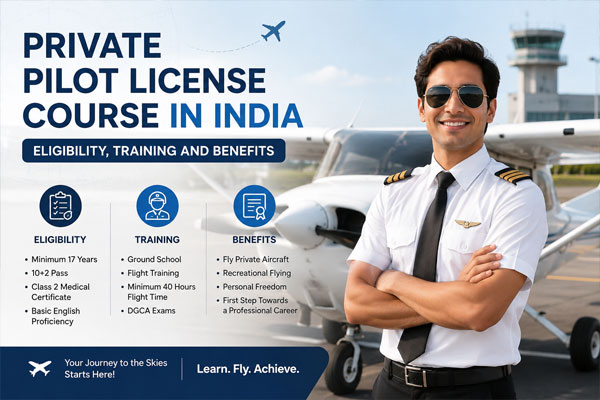
Eligibility for a Private Pilot License Course in India
Educational Qualification
Candidates applying for a PPL should have passed Class 10 or an equivalent examination from a recognised board. Unlike a Commercial Pilot License, Physics and Mathematics at the 10+2 level are not generally required for the PPL category.
Age Requirement
A candidate must be at least 17 years old when applying for the final Private Pilot Licence. Younger students may contact the academy to understand when ground training and initial preparation can begin.
Medical Fitness
Students need suitable aviation medical fitness. Aerostar lists a Class II medical assessment as part of its PPL eligibility requirements. The examination helps determine whether the applicant is medically fit for safe flight training.
English Proficiency
A student pilot should be able to understand, read and communicate in English. English is important for ground subjects, flight instructions, aviation terminology and radio communication. Aerostar specifically notes that PPL students should be proficient in English.
Skills You Develop During PPL Training
A Private Pilot License course in India is not limited to learning how to move aircraft controls. It develops several valuable skills.
Students learn:
- Situational awareness
- Decision-making under pressure
- Route planning
- Weather interpretation
- Radio communication
- Time management
- Safety discipline
- Technical understanding
Why Choose Aerostar Aviation Academy?
Aerostar Aviation Academy supports students interested in aviation education and pilot training. Its published PPL programme includes ground-subject preparation, simulator sessions and flying training using a Cessna 172.
The academy lists centres or admission support across Ahmedabad, Vadodara, Surat and Rajkot, along with online-academy options for selected learning support.
Students considering admission should directly confirm the latest information regarding:
- Current course fees
- Flying location
- Aircraft availability
- Medical requirements
- Examination support
- Training schedule
- Course inclusions
- Licence documentation
- Refund and cancellation terms
FAQs – Airport Management
A candidate should have passed Class 10 or an equivalent examination from a recognised board.
The applicant must be at least 17 years old when applying for the final licence.
No. A Private Pilot License is for non-commercial flying and does not permit the holder to work as a paid pilot.
Aerostar lists its PPL course duration as approximately six months. Completion time may vary according to training progress and operational conditions.
Aerostar lists the Cessna 172 for its Private Pilot License training programme.
Major subjects include Air Regulations, Air Navigation, Aviation Meteorology, Technical General and aircraft-specific technical knowledge.
Yes. Aerostar lists Class II medical fitness as a requirement for its PPL programme.
A PPL can provide useful foundational flying experience, but students must separately fulfil all current educational, medical, examination and flying requirements applicable to a Commercial Pilot License.