


Private Pilot License Course India: Your Complete Guide to Learning to Fly
For many people, flying an aircraft is a lifelong dream. You may want to fly for personal travel, experience aviation as a hobby, or understand whether becoming a professional pilot is the right career path for you. A Private Pilot License Course in India can be the first practical step toward achieving that dream.
A Private Pilot License, commonly known as a PPL, allows a qualified person to operate an aircraft for private purposes. Unlike a Commercial Pilot License, a PPL does not permit you to fly professionally for payment.
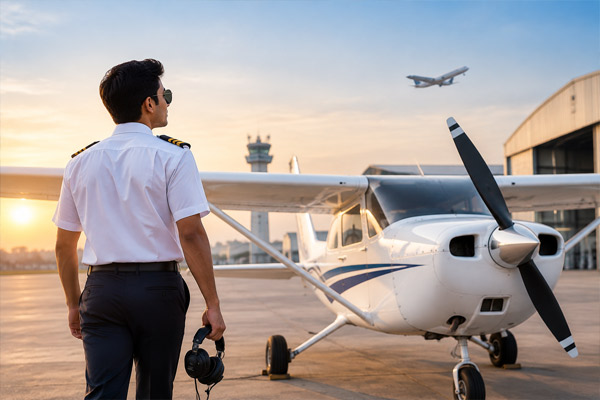
At Aerostar Aviation Academy, students can learn aviation theory, prepare for relevant DGCA examinations, gain simulator experience, and complete practical flight training as part of their journey toward a Private Pilot License. Aerostar currently lists its PPL program as a six-month course using the Cessna 172 for flight training.
What Is a Private Pilot License?
A Private Pilot License in India is a pilot qualification intended primarily for private and recreational flying.
Once you meet the applicable licensing requirements, a PPL can allow you to operate approved aircraft within the privileges and limitations of your licence.
The most important difference is simple:
PPL = Private flying
CPL = Commercial flying for remuneration
Aerostar describes the PPL as a qualification that enables the holder to act as a hobby pilot and not receive payment for flying.
Who Should Consider a Private Pilot License Course in India?
A PPL is not only for students planning to join an airline.
It may be suitable for:
- Aviation enthusiasts who want to learn aircraft flying
- Business owners who are interested in private aviation
- Students exploring a future pilot career
- Professionals looking for recreational flying experience
- People who want to understand aviation practically
- Future CPL candidates who want an introduction to flying
A PPL can help you experience real pilot training before deciding whether you want to pursue more advanced aviation qualifications.
Eligibility for Private Pilot License Course in India
Eligibility is one of the first things students ask about.
Aerostar lists Class 10 pass as the academic eligibility for its Private Pilot License course. The DGCA Pariksha guidance also notes that Class 10 educational qualification is sufficient for the PPL examination/computer-number category.
Aerostar’s published PPL course information includes:
Course
Private Pilot License PPL
Duration
6 Months
Educational Eligibility
Class 10 Pass
Medical
Class II Medical
Training Aircraft
Cessna 172
Single Engine Flying
40 Hours
Simulator Training
10 Hours
Solo Flying
Minimum 20 Hours
Language
Proficiency in English
These are the academy’s currently published course details. Final licensing, medical, examination, and flying requirements are governed by the applicable DGCA rules and should always be confirmed before enrolment or licence application.
Medical Requirement for Private Pilot Training
Flying requires physical and mental fitness.
Aerostar lists Class II Medical as part of its PPL course requirements.
An aviation medical assessment is different from an ordinary general health check because it considers whether a candidate is medically fit to safely operate an aircraft.
Students should complete the appropriate medical process early rather than waiting until much later in their training.
Step-by-Step PPL Training Journey
A simple way to understand the process is:
Step 1: Understand Your Goal
Decide whether you want a PPL for recreation or as an introduction to a future professional flying career.
Step 2: Check Eligibility
Verify academic, age, language, medical, and other current licensing requirements.
Step 3: Complete the Required Medical Process
Aerostar lists Class II Medical for its PPL program.
Step 4: Begin Ground School
Study aviation regulations, navigation, meteorology, and aircraft technical subjects.
Step 5: Prepare for DGCA Examinations
Students need a strong understanding of the relevant subjects rather than simply memorising answers.
DGCA’s published study-material guidance for PPL examinations includes areas such as air law, navigation, communications, aircraft knowledge and associated aviation subjects.
Step 6: Start Practical Flight Training
Learn aircraft handling under instructor supervision.
Step 7: Complete Simulator Training
Practise selected procedures in a simulated cockpit environment.
Step 8: Progress Toward Solo Flying
Your instructor assesses whether you are ready to perform solo exercises.
Step 9: Complete Required Training and Assessments
Finish the applicable flying experience, examinations and checks required for your training and licence application.
Step 10: Apply for the Licence
Complete the required DGCA processes and documentation in accordance with current rules.
Private Pilot License vs Commercial Pilot License
Students often ask whether PPL and CPL are the same.
They are not.
| PPL | CPL |
|---|---|
| Private Pilot License | Commercial Pilot License |
| Mainly for personal/recreational flying | Designed for professional commercial flying |
| Cannot be used to earn remuneration as a pilot | Allows commercial pilot privileges subject to regulations |
| Aerostar lists Class 10 eligibility | Aerostar lists 12th with Physics, Maths and English for CPL |
| Aerostar lists 6-month program | Aerostar lists 18-month program |
| Lower training-hour requirement | Much higher flying-hour requirement |
Aerostar’s CPL program lists 200 total flying hours, while its PPL course has a significantly smaller training structure.
Benefits of Completing a Private Pilot License Course
Learn to Fly an Aircraft
The biggest benefit is gaining real experience in aircraft operation.
Understand Whether Pilot Training Is Right for You
A PPL gives you practical exposure before committing to more extensive commercial training.
Build Aviation Knowledge
Navigation, weather, regulations, aircraft systems and flight planning become much easier to understand once you combine classroom learning with practical flying.
Develop Decision-Making Skills
Pilots constantly evaluate weather, aircraft condition, fuel, routes and safety.
Build Confidence and Discipline
Aviation training requires preparation, concentration, responsibility and consistency.
Enjoy Recreational Aviation
A PPL is particularly valuable for people who genuinely want to fly because they enjoy aviation rather than because they want employment as a pilot.
Conclusion
A Private Pilot License Course in India gives aviation enthusiasts an opportunity to move from simply watching aircraft to learning how to fly one.
The journey combines aviation theory, simulator sessions, instructor-led flying and solo flight experience. Along the way, students learn navigation, meteorology, air regulations, aircraft systems, flight planning and, most importantly, aviation safety.
Aerostar Aviation Academy offers a structured PPL program with Cessna 172 flight training, simulator exposure, DGCA examination preparation and ground-school subjects for students interested in private flying.
If flying has always been your dream, understanding the eligibility, medical requirements, training process and licence privileges is the right place to begin.
Frequently Asked Questions About Private Pilot License Course India
A Private Pilot License course trains a student in aviation theory and practical flying so they can work toward obtaining a licence for private, non-commercial flying.
No. A PPL is intended for private flying and does not provide the commercial privileges required to work as a paid pilot. Aerostar describes its PPL specifically as a hobby-pilot qualification without remuneration.
Aerostar lists Class 10 pass as eligibility for its PPL course. DGCA Pariksha documentation also notes that only Class 10 educational qualification is required for the PPL category.
Aerostar lists a course duration of approximately six months. Actual completion can vary depending on training and operational factors.
Aerostar lists the Cessna 172 for its Private Pilot License training.
Aerostar’s published course page lists 40 hours in a single-engine aircraft plus 10 hours of simulator training, with a minimum of 20 hours of solo flying.
Yes. Aerostar lists Class II Medical as part of its PPL course requirements.
Aerostar lists Air Regulations, Air Navigation, Aviation Meteorology, Technical General and Cessna 172-specific technical subjects.
Yes. Aerostar notes that PPL students should be proficient in English because aviation instruction, communication and technical materials rely heavily on English.
Yes, you can later pursue CPL if you meet its separate academic, medical, examination, flight-training and DGCA licensing requirements.
Aerostar lists Class 10 as the educational eligibility for its PPL course, and DGCA’s Pariksha material notes the same educational level for the PPL examination category.
Aerostar has centres across major Gujarat cities including Ahmedabad, Baroda, Rajkot and Surat. Its official contact page provides centre-specific contact information.